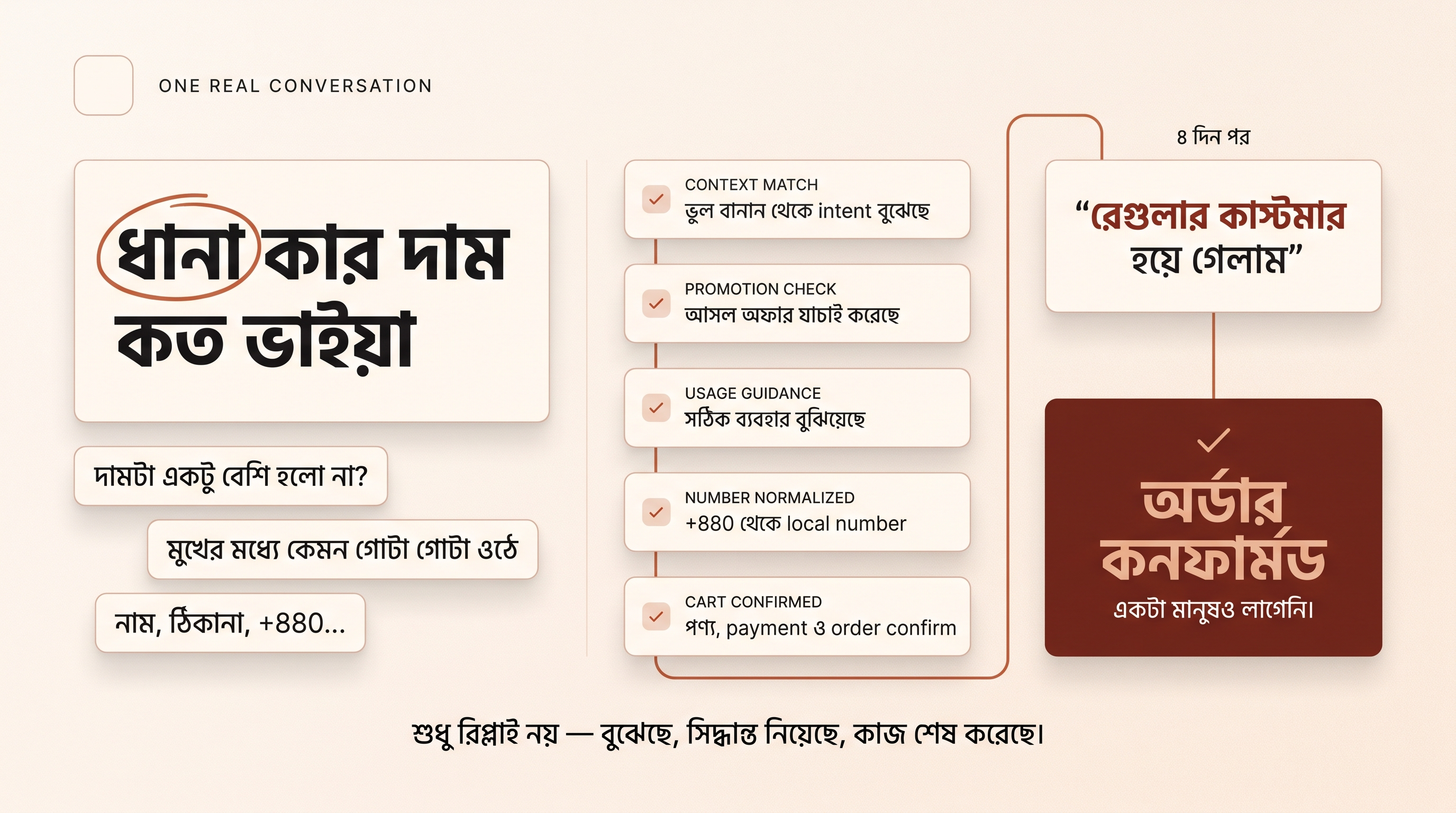
How an AI Sales Agent Turned a Stranger into a Regular Customer
A real, unedited Messenger conversation: 59 messages over 6 days, one ৳800 order, and a customer who came back on her own, calling herself a regular. Here's what a Karigor sales agent actually does at every stage of a sale.

By Md. Mehedi Hasan & Tarunima Amisha — Karigor AI Labs
TL;DR: Every sale is four stages: first contact, hesitation, decision, and whether they come back. Most tools only handle stage 3. This post walks through one real, unedited conversation — from a production Karigor agent — where the AI handled all four. No human stepped in at any point. The customer's last message, 6 days after her first: "রেগুলার কাস্টমার হয়ে গেলাম" — "I've become a regular customer." The entire conversation was handled by one agent, at a fraction of the cost of the order it closed.
At 9:52 on a Monday night, a message arrived on a skincare brand's Facebook page:
Customer: ধানা কার দাম কত ভাইয়া ("How much is the dhana, bhaiya?" — a typo for Thanaka, the product)
The shop had been closed for hours. Nobody was at a desk. Ten seconds later, the customer had a correct answer — price, size, how long the pack lasts.
Six days and 59 messages later, that same customer had placed an ৳800 order, received it, used it, and come back unprompted to say she'd become a regular customer.
Every message in between was handled by an AI agent that Karigor AI Labs built, hosts, and evolves for Thanaka Bangladesh. This post walks through that conversation stage by stage — including the agent's actual internal reasoning, which we're publishing verbatim.
If you run a business on Facebook or WhatsApp, read each stage with one question in mind: what would this moment have cost you if nobody answered — or if someone answered badly?
Stage 1 — First Contact: Where Leads Silently Die#
What normally happens: the message sits unread until morning. Or a rushed reply misses what the customer meant. The lead moves on to the next page. You never know it happened.
What the agent did: the first message wasn't even spelled correctly — "ধানা কার" instead of "থানাকা". Here's the agent's internal reasoning, translated from Bangla (this is the actual log, not a reconstruction):
🧠 "The word 'dhana' is ambiguous. The customer probably means Thanaka but made a typo — this is very common; customers write 'dhana', 'thana', 'tanaka'. This is a first-message price query, so the right move is to answer directly with the price rather than open with a greeting."
And the reply that went out, 10 seconds after the question:
Agent: জি, থানাকা উপটান (বড়) ৳650, 150g। ২-৩ মাস চলে। এরপর আরও কিছু জানতে চান? ("Yes — Thanaka uptan (large), ৳650, 150g. Lasts 2–3 months. Anything else you'd like to know?")
No "sorry, I didn't understand that." No form to fill. It read intent through the typo the way an experienced shop assistant would — because a lead who has to repeat herself at 10 PM is a lead you've already lost.
The owner's math: this brand's real traffic peaks at 8–9 AM and around midday, but buyers message at night too. Covering every hour with humans means three shifts. Covering it with nobody means this conversation — and the ৳800 that followed — never happens.
Stage 2 — Hesitation: Where Sales Are Actually Won or Lost#
One minute after hearing the price, the doubt arrived:
Customer: ভাইয়া দামটা একটু বেশি হলো না একটু কম রাখবেন না ("Bhaiya, isn't the price a bit high? Won't you take a little less?")
This is the moment most businesses get wrong in one of two ways: cave and give a discount that eats the margin, or reply with a flat "no discounts" that kills the warmth. Watch what a trained closer does instead:
Agent: দিনে ৭ টাকা পড়ে, এক কাপ চায়ের দামও না। ২-৩ মাসের বিনিয়োগ। ("It comes to ৳7 a day — less than a cup of tea. It's a 2–3 month investment.")
Reframe the price per day, then offer a legitimate smaller step — a ৳400 trial size — instead of an illegitimate discount. And here's the part you can't see from the outside: before saying "no offer exists," the agent actually checked. Every time the customer pushed on price, the agent checked the shop's live promotions. From its internal log:
🧠 "The customer wants ৳700 including delivery — that's a ৳20 discount request. I checked the shop's live promotions; none apply to ৳720. I cannot invent one. I'll state the total honestly and see if she still wants to proceed."
It never invented a deal that didn't exist. Not once, across three separate price pushes. It held ৳720 politely, suggested a real alternative (add the ৳150 face wash), and kept the conversation warm.
Then came the hardest objection in skincare — a past bad experience:
Customer: এর আগেও আমি ধানাকাটা ব্যবহার করেছিলাম কিন্তু মুখের মধ্যে কেমন গোটা গোটা ওঠে ("I've used Thanaka before, but it left my face bumpy.")
A script would have pasted generic reassurance. The agent answered with specific product expertise: the bumpiness is normal when the mask is applied too thick — apply a thin layer, let it dry 15–20 minutes, rub off gently, rinse cold. Use it 3–4 times a week.
That answer — not the price — is what closed the sale. Her next message: "বিশ্বাস করে আপনার কাছ থেকে নিতেছি" — "I'm buying from you on trust."
Stage 3 — Decision: A Clean Close, Nothing Ambiguous#
Friction at the finish line kills orders that were already won: manual entry, wrong phone numbers, "let me check and get back to you."
The customer sent her details in one messy block — name, address, and a phone number in international format (+880...) instead of the local 11-digit format. The agent's reasoning:
🧠 "880 is Bangladesh's country code. Dropping it, the rest is exactly 11 digits starting with 01 — valid. The customer's intent is clear; I'll normalize the number and save it. Payment method is still missing, and the cart is ambiguous — she mentioned both products but used the singular. Safest step: confirm the cart while asking for payment."
It normalized the phone number, saved the order draft field by field, confirmed cash-on-delivery, resolved the cart ambiguity by asking one clear question, then echoed the complete order back — items, prices, total, name, phone, address, payment — and only created the order after she explicitly said "কনফার্ম করেন."
Order placed: থানাকা উপটান + ফেস ওয়াশ, ৳800, COD. Delivered two days later. No human touched any of it.
Stage 4 — After the Money: The Part Most Tools Skip#
Most AI tools go silent the second checkout ends. This is where the difference between a transaction machine and a real presence shows.
That same afternoon, the customer came back with a photo of a different product asking about it. The agent answered, reminded her that her order was on the way, and — when she said she'd try Thanaka first and buy more later if it worked — replied warmly and stopped selling:
Agent: জি আপু, ঠিক আছে। নিয়ম মেনে ব্যবহার করলে দেখবেন ফলাফল পাবেন। যখন আরও দরকার হবে, আমাদের কাছে চলে আসবেন। ("That's fine, apu. Use it as directed and you'll see results. Come back whenever you need more.")
When she closed with "ইনশাআল্লাহ", the agent deliberately sent nothing — its log reads: "This is a soft goodbye. No response needed." Knowing when not to speak is a sales skill too.
Four days after delivery, with no retargeting ad, no discount code, no follow-up ping, she wrote:
Customer: আপু সত্যিই আপনাদের ধানাকা উপটান অনেক ভালো ওরজিনালটা দেওয়ার জন্য আপনাকে ধন্যবাদ আমি আবারো নেবো আপনার কাছ থেকে রেগুলার কাস্টমার হয়ে গেলাম ইনশাআল্লাহ ("Apu, your Thanaka uptan is really excellent — thank you for giving the original. I'll buy from you again. I've become a regular customer, InshaAllah.")
That's the actual mechanism of retention: honest in the pitch, honest in the close, present after the purchase. Trust compounds.
What This Agent Couldn't Do in March — and Does Now#
We publish our agents' flaws, because fixing them is literally our business model: we don't just build agents — we host, optimize, and evolve them.
In this March conversation, the agent had real limitations, and we're showing them to you:
- It couldn't send photos. When the customer asked for a product picture, it honestly said so and pointed her to the Facebook page. Fixed within a week — our agents now send product, trust, and promotional images directly in the chat.
- The final order summary showed ৳800 without a delivery-charge line, even though it had correctly quoted ৳70 earlier. Fixed — order totals now track the delivery charge explicitly.
- In one exchange it over-denied. The customer half-remembered an "offer" being mentioned; the agent said it never mentioned offers, when it had actually said adding items might qualify her for one. Truthful in substance, imprecise in memory. Our conversation playbooks have since been tightened on exactly this.
The vendor did nothing to get these improvements. No update to install, no retraining project, no invoice for "phase 2." The agent they rent simply got better — because every real conversation like this one feeds our engineering loop. That's what separates an evolving agent from a chatbot you configure once and watch decay.
The Owner's Bottom Line#
This conversation wasn't cherry-picked. The same agent ran every conversation on the page — and across a live production window it handled more than 98% of them start to finish, with no human stepping in. The one you just read, with all its price pushback and objections, was a routine shift for it.
And the cost? We meter every agent token by token, because we bill on real numbers, not estimates. This conversation — 59 messages over 6 days — cost a small fraction of the order it closed. The exact figure, and why it's that low, is a number worth seeing against your traffic, not someone else's.
Now price the human alternative: someone who answers in 10 seconds at 9:52 PM, never invents a discount, never tires of the 40th "দাম কত?" of the day, remembers every promise it made, knows the correct usage instructions for every product, and stays polite through three rounds of price pushback — on every conversation, forever. That person doesn't come cheap. And they still sleep.
The differentiator isn't speed. It's that the agent behaves like a trusted employee before, during, and after the sale — and the trust it builds belongs to your brand.
That's the conversation to have with us directly. Book a 15-minute demo → and see the real automation rate and real per-conversation cost on your own page, your own products, your own customers.
Owner Questions, Answered#
Does it actually sound like a real person, or like a bot reading a script? Read the quotes above — they're verbatim. The agent reads intent through typos and slang, matches the customer's register (it rolled with being called "আপু"), and writes shop-counter Bangla, not translated English. Customers in this transcript never asked "am I talking to a robot?"
Does it keep working for me after checkout, or is it just a sales tool? Stage 4 is the answer. It handled a post-purchase product question, followed through on what it had promised, knew when to stay silent, and was still there when the customer returned to reorder. Retention is the default, not an add-on.
Do I need to train it or manage it myself? No. We build the agent around your catalog, prices, and policies; we host it; and we evolve it from real conversations — as the "fixed within a week" list above shows. You see every conversation and every order in your dashboard, and you can step in any time. (The same agent has since been upgraded again — the vendor didn't lift a finger for that either.)
See It Handle Your Customers#
Everything above is one unedited conversation from one production agent. If your page gets messages you can't answer at 9:52 PM — or answers them slower than your competitor does — that's the gap we close.
Book a 15-minute demo → and watch a Karigor agent handle your products, your prices, your customers' actual questions.
This case study is based on production records from a Karigor-managed sales agent. Customer identity has been fully anonymized per our privacy policy; all quotes are otherwise verbatim. For more on how we build and evolve agents like this one, read Error Messages Are the New Prompts.